comparison
D1110, D4346, and D4910: Which Hygiene Code Fits Which Patient
Three hygiene codes, three different patients. Here is what each one requires in the chart, how plans treat frequency, and how the code you choose sets the recall interval you will schedule.
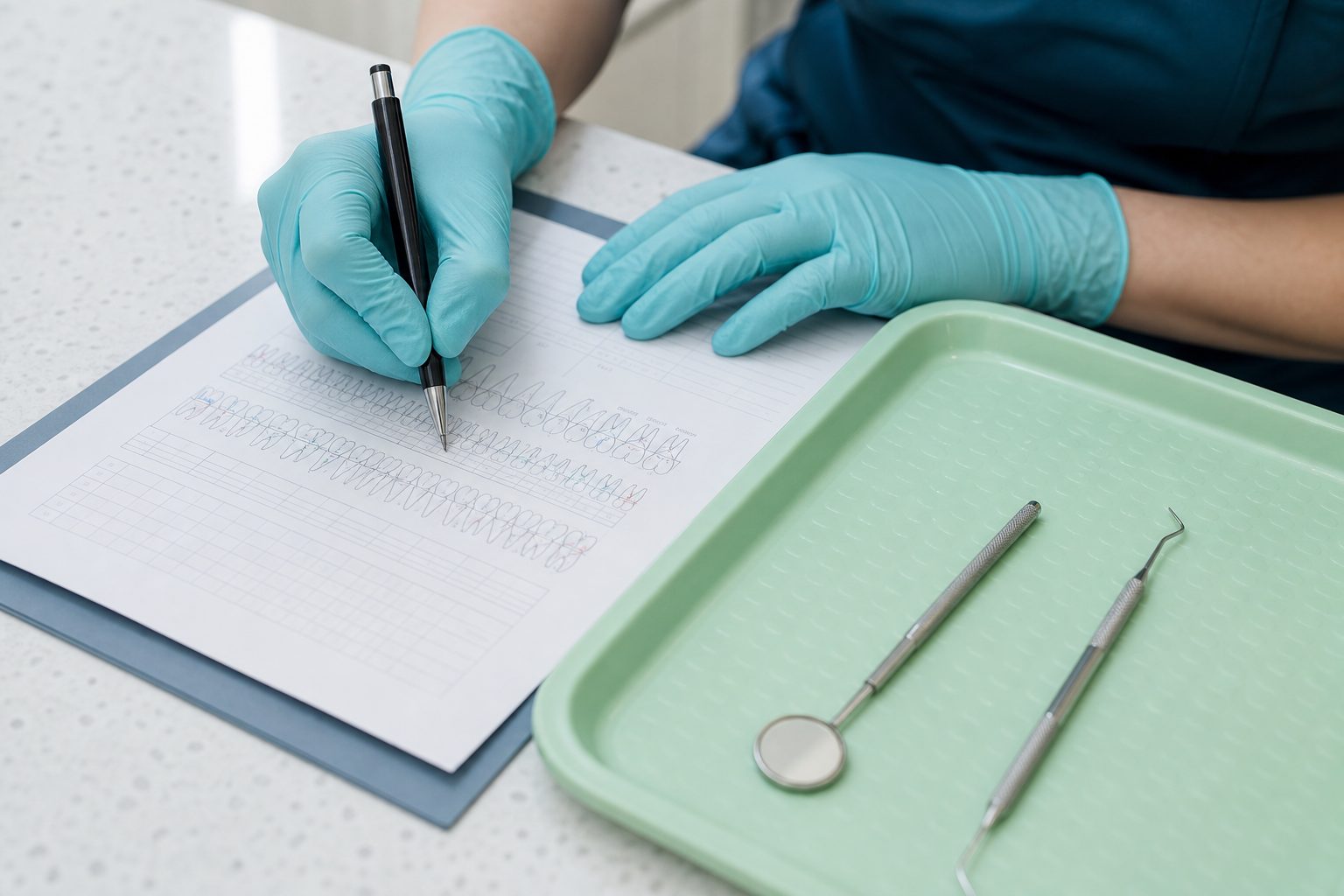
What D1110 Covers and the Point Where a Patient No Longer Fits It
D1110 is the code for an adult prophylaxis. This procedure is for patients with healthy periodontium or localized mild gingivitis. The work includes removal of plaque, calculus, and stains from the tooth surfaces, above the gumline and just below it. It does not address deeper pockets or active periodontal disease.
Most adults who come in regularly and show no signs of periodontitis fit this code. The clinical notes should show minimal bleeding, no probing depths over 3 millimeters, and a stable bone level. The procedure is routine and preventive, not therapeutic.
Problems arise when a patient's periodontal measurements shift. If you see persistent inflammation, pockets deeper than 3 millimeters, or radiographic evidence of bone loss, it is time to reconsider the code. D1110 no longer fits patients with generalized moderate to severe gingivitis or those with a history of scaling and root planing who now need maintenance.
Keep reading: Seven Recall Mistakes That Keep Overdue Patients Off the Books
D4346 and the Definition of Generalized Moderate to Severe Gingivitis
D4346 covers scaling in the presence of generalized moderate or severe gingival inflammation. This is for patients who do not yet have periodontitis, but have heavy bleeding and swelling on exam. The tissue may be erythematous, edematous, and bleed on gentle probing. Pockets remain at 3 millimeters or less, and there is no attachment loss or bone loss visible on radiographs.
This code was introduced to fill the gap between prophy and scaling and root planing. To use D4346, your records should document inflammation in most of the mouth, not just isolated areas. If only one or two quadrants show mild changes, D1110 still applies. D4346 is for cases where inflammation is a widespread problem, but the underlying bone and attachment have not yet broken down.
The procedure involves removing plaque and calculus, but with special attention to inflamed tissue. Often, patients who receive D4346 need a follow-up prophy in a few weeks to re-evaluate tissue health and reinforce home care.
D4910 and Why It Requires Prior Scaling and Root Planing
D4910 is the code for periodontal maintenance. This is not a routine cleaning but an ongoing therapy for patients with a history of periodontitis. To bill D4910, the patient must have completed scaling and root planing in the past, or equivalent periodontal therapy. This should be documented in the chart, with dates of SRP and the diagnosis of periodontitis.
The maintenance procedure includes everything in a prophy, plus site-specific scaling and root planing where needed. It may also include reviewing changes in periodontal status, updating the patient's home care, and applying localized antimicrobials. The goal is to prevent further attachment loss, control inflammation, and monitor the periodontium for relapse.
Patients who have never had SRP or who do not have a diagnosis of periodontitis do not qualify for D4910. For them, D1110 or D4346 may be the correct code, based on the current periodontal status. Insurance carriers often check for previous SRP codes when D4910 is submitted, and denials are common if there is no such history in the record.
Keep reading: Texting Patients About Overdue Cleanings: HIPAA and TCPA Rules
Chart Evidence Each Code Needs: Probing Depths, Bleeding Points, Radiographs
D1110 Documentation
For D1110, your records should show normal or near-normal findings. Probing depths should be 1 to 3 millimeters, with minimal or no bleeding on probing. Any bleeding should be localized and mild, not generalized. Radiographs should show stable bone levels with no signs of loss. Noting oral hygiene habits and frequency of home care helps as well.
D4346 Documentation
D4346 requires documentation of generalized moderate or severe gingival inflammation, with no attachment or bone loss. Your chart should record bleeding on probing in most areas, swelling, redness, and tissue changes. Probing depths do not exceed 3 millimeters, and recent radiographs confirm no bone loss. A statement in the chart should make clear that inflammation is widespread, not limited to a few teeth.
D4910 Documentation
D4910 requires the most detailed documentation. Past SRP dates and the diagnosis of periodontitis must be in the records. Current probing depths may vary, but there should be areas of 4 millimeters or more, with evidence of attachment loss. Bleeding on probing should be recorded by site. Radiographs should show bone loss consistent with a history of periodontitis. Chart notes should mention the periodic nature of maintenance and any site-specific therapy performed at the visit.
Frequency Limits and Plans That Alternate D4910 With D1110
Most dental plans limit D1110 to twice per year, though some allow three or four times. D4346 is often treated as a one-time code, used to address inflammation that has not responded to routine care. After D4346, patients usually return to D1110 or move to SRP or D4910 depending on their condition.
D4910 is usually covered every three or four months, reflecting the higher risk of relapse after periodontitis. Some plans strictly deny D1110 for patients on maintenance, while others alternate D4910 and D1110 every other visit. This can cause confusion for patients and teams. If a plan only allows two hygiene visits per year after SRP, and expects the codes to alternate, the practice must coordinate the recall schedule and be clear in patient communication.
Some carriers limit the total number of hygiene visits per year, regardless of code. Others require a specific interval between D4910 procedures, such as 91 days. Knowing each plan's rules keeps the schedule full and reduces denials. It is important to check benefit limitations and communicate these to patients before treatment.
See how ChairGap handles this for dental practices
Setting the Recall Interval to Match the Code
The recall interval is tied to the patient's risk and the code billed. For D1110, most practices schedule every six months. This fits with most insurance plans and works well for patients with low risk. Some high-risk patients may need D1110 every four months, but plan coverage may not keep up.
D4346 is different. It is typically a one-off code, used to break the cycle of inflammation. After D4346, a re-evaluation in four to six weeks is common. At that point, the patient either returns to D1110 or moves to SRP and, eventually, D4910 if periodontitis develops.
For D4910, the recall interval is three to four months. This is based on evidence that maintenance patients have a higher risk of recurrence if seen only twice per year. Most plans follow this schedule, but the practice must monitor for exceptions, especially when plan rules require alternating codes or limit the number of allowed visits. Each hygiene visit should be scheduled before the patient leaves, with clear communication about the reason for the interval.
Common Denials and the Narrative That Answers Them
D1110 Denials
Denials for D1110 often occur if the patient has a history of periodontitis or previous SRP. Insurance may state that D4910 is now the only covered hygiene code for this patient. The response is to provide documentation that the patient no longer has active periodontitis, if true, and that maintenance is not required. If the patient is on maintenance, D4910 is the correct code.
D4346 Denials
D4346 is a newer code and not all plans cover it. Some reject it as "not a covered benefit" or request more evidence that moderate to severe inflammation is generalized. The narrative should include a description of the extent and severity of gingivitis, number of teeth involved, bleeding score, and the absence of bone or attachment loss. Attaching a copy of current periodontal charting and radiographs often helps.
D4910 Denials
For D4910, the most common denial is lack of documentation of prior SRP or periodontitis. Carriers check claims history for SRP codes and chart notes confirming diagnosis. If denied, submit documentation of previous SRP, include the dates, and reference radiographs showing bone loss. Narratives must make clear this is ongoing maintenance for a history of periodontitis, not a routine cleaning.
Another denial appears when D4910 is billed too soon after SRP, or when the recall interval does not match the plan's rules. In these cases, include a narrative explaining the patient's high risk and the clinical need for the timing, along with evidence from the chart.
Clear, specific narratives and timely submission of supporting documentation reduce denials. Templates in the practice management system can speed up this process, but each claim should be tailored to the patient's history and current findings.
Closing: Matching Codes, Schedules, and Communication Tools
Selecting the correct hygiene code starts with an accurate diagnosis and thorough documentation. Matching the code with the patient's clinical findings and risk factors leads to proper recall intervals and fewer insurance denials. Keeping track of which patients fall into which category, and contacting those overdue for maintenance or recall, takes up valuable staff time. Tools that generate overdue hygiene lists and send quick SMS reminders help fill the schedule and ensure patients return at the right time, especially for practices where one missed appointment leaves a noticeable gap in the week.
Seven Recall Mistakes That Keep Overdue Patients Off the Books
Most hygiene recall systems fail in the same seven places: the list, the reset rules, the ask, the channel, the wording, the cleanup, and the person who owns it after five o'clock.

Texting Patients About Overdue Cleanings: HIPAA and TCPA Rules
Two separate rulebooks govern a recall text: HIPAA decides what the message may say, and the TCPA decides whether you may send it at all. Here is what each one requires of a dental office.
Replacing Recall Postcards With a Texted Overdue List: A Case
A composite walkthrough, built from how small offices actually run recall, of a two chair practice retiring its monthly postcard run and rebuilding the same job around a texted overdue list.